
By Tyler Henderson · Published September 6, 2026 · Updated September 13, 2026
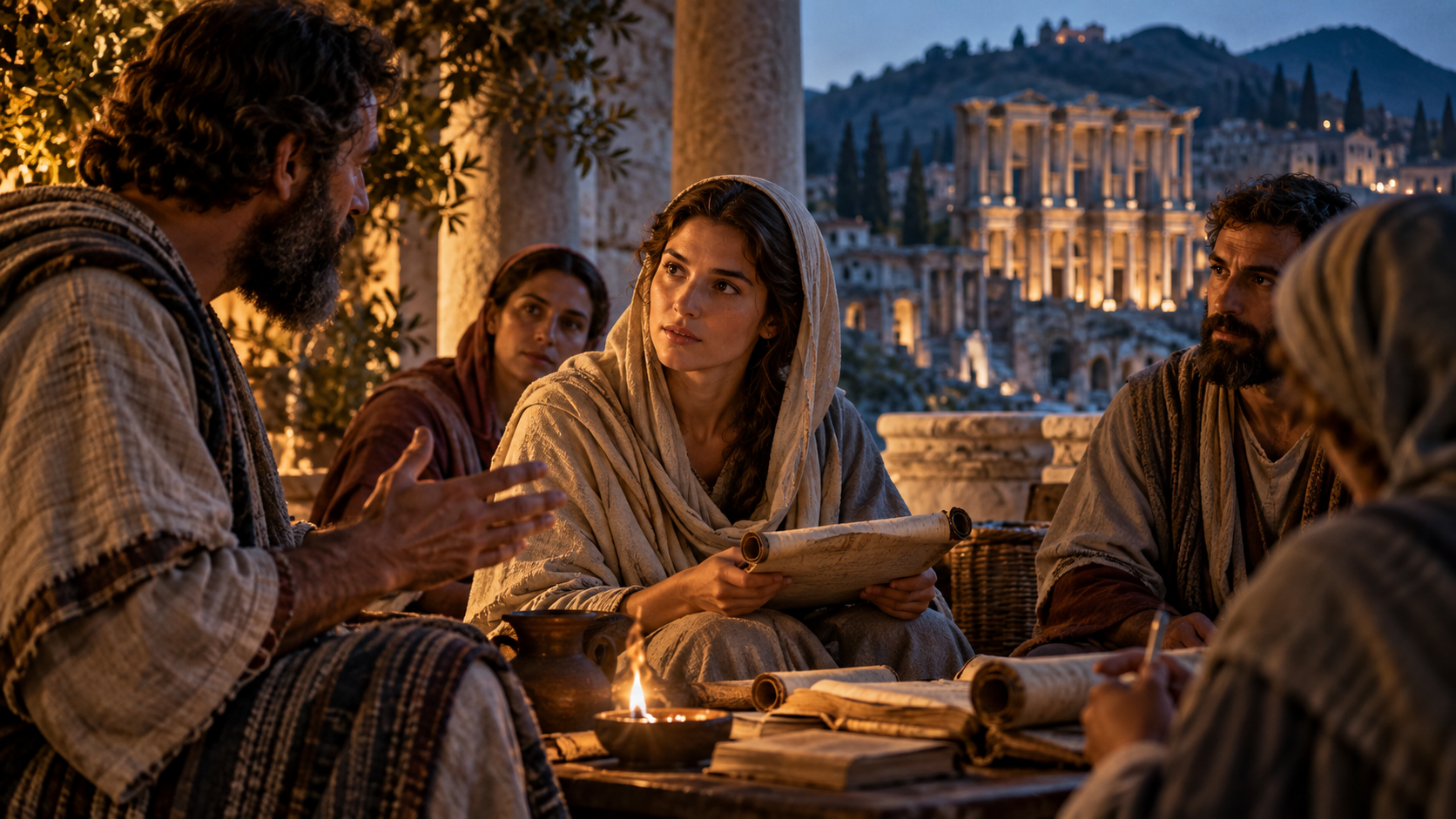
Let a Woman Learn
Reading 1 Timothy 2:11-12 in the Context of the Bigger Picture
Short Answer
The discussion surrounding 1 Timothy 2 often begins with Paul saying, “I do not permit a woman to teach or to exercise authority over a man” (1 Timothy 2:12). But Paul’s instruction actually begins one verse earlier:
“Let a woman learn…” (1 Timothy 2:11).
This inherently matters because 1 Timothy was written into an Ephesian church already under attack from false teaching. Years earlier, Paul warned the Ephesian elders that wolves would arise from within the church and distort the truth (Acts 20:28–31). By the time of 1 Timothy, people were teaching false doctrine, some wanted to teach despite not understanding what they confidently asserted, and Paul could identify destructive figures such as Hymenaeus by name (1 Timothy 1:3–7, 19–20; 2 Timothy 2:16–18).
The letters also reveal vulnerable women within this crisis. Some younger widows were moving from house to house “saying what they should not,” while 2 Timothy describes corrupt teachers entering households and gaining influence over vulnerable women who were “always learning and never able to arrive at a knowledge of the truth” (1 Timothy 5:11–15; 2 Timothy 3:6–7).
One historically plausible reconstruction is that some Ephesian women with limited educational and theological formation had been influenced by false teachers and were vulnerable to repeating what they had learned. Paul’s solution in 1 Timothy 2 accomplishes two things at once: stop the transmission of error and teach those who had been misled the truth.
This does not require a universal prohibition against theologically formed women serving alongside men. Paul’s ministry included women such as Priscilla, Phoebe, Junia, Lydia, Euodia, Syntyche, and others in meaningful gospel work (Acts 16:11–15, 40; 18:18–28; Romans 16:1–16; Philippians 4:2–3).
The enduring pastoral principle may therefore be broader than gender:
People who have been misled must be formed before they are entrusted to form others.
The wolves needed confrontation. The people they deceived needed discipleship.
And Paul’s instruction to the latter begins:
“Let a woman learn…”
(Acts 16:11–15, 40; 18:18–28; 20:17, 28–31; Romans 16:1–16; 1 Corinthians 1:11; 11:5; 14:26–40; 16:19; Ephesians 4:11–16; Philippians 4:2–3; Colossians 4:15; Philemon 1–2; 1 Timothy 1:3–7, 18–20; 2:1–15; 3:1–13; 4:1–16; 5:3–16, 17–22; 6:3–5, 20–21; 2 Timothy 1:5, 13–14; 2:1–2, 14–18; 3:1–17; 4:1–5)
The Full Answer
Few passages in Scripture generate more immediate debate about men and women than 1 Timothy 2:11–12.
The discussion usually begins here:
“I do not permit a woman to teach or to exercise authority over a man” (1 Timothy 2:12).
Does this prohibit all women from teaching men? Does it describe the governing authority of a particular church office? Is the restriction universal? Or is Paul responding to a particular crisis in Ephesus?
Those are legitimate questions. But there is a danger in beginning the discussion one verse too late.
Before Paul says, “I do not permit,” he says:
“Let a woman learn quietly with all submissiveness” (1 Timothy 2:11).
Whatever conclusions we reach about verse 12, verse 11 cannot disappear. Paul does not tell Timothy to keep women away from theology or respond to doctrinal confusion by preserving their ignorance.
He says, “Let a woman learn.”
When we follow the Ephesian church through time, that command begins to sound less like an incidental introduction to a prohibition and more like part of Paul’s solution to a pastoral emergency.
Paul Had Already Warned Ephesus About the Wolves
Years before 1 Timothy, Paul gathered the Ephesian elders and warned them about what would happen after his departure (Acts 20:17).
“I know that after my departure fierce wolves will come in among you, not sparing the flock” (Acts 20:29).
The danger would not come only from outsiders:
“From among your own selves will arise men speaking twisted things, to draw away the disciples after them” (Acts 20:30).
The wolves would emerge from inside the Christian community, distort the truth, gain followers, and prey upon the flock. Paul therefore told the elders, “Be alert” (Acts 20:31).
By 1 Timothy, that warning had become a crisis. Paul tells Timothy to remain in Ephesus so that he can “charge certain persons not to teach any different doctrine” (1 Timothy 1:3). These people are occupied with myths and endless genealogies, producing speculation rather than faithful stewardship (1 Timothy 1:4). Some have wandered into vain discussion (1 Timothy 1:6).
Paul then gives an especially revealing description:
“desiring to be teachers of the law, without understanding either what they are saying or the things about which they make confident assertions” (1 Timothy 1:7).
They want to teach. They speak confidently. But they do not understand what they are saying.
Some of the destructive figures can even be named. Hymenaeus and Alexander have rejected faith and a good conscience and “made shipwreck of their faith” (1 Timothy 1:19–20). Later, Hymenaeus appears again with Philetus, teaching that the resurrection has already happened and “upsetting the faith of some” (2 Timothy 2:16–18).
We cannot prove that these men were the exact individuals Paul envisioned in Acts 20, but the danger he predicted had clearly materialized.
For Ephesus, the wolves were no longer hypothetical.
The False Teachers Were Reaching Vulnerable People
In 1 Timothy 5, Paul addresses the church’s care for widows and warns that some younger widows can become idle, “going about from house to house,” becoming “gossips and busybodies, saying what they should not” (1 Timothy 5:13).
Then he adds:
“For some have already strayed after Satan” (1 Timothy 5:15).
The text does not explicitly say that the things these women were saying came from Hymenaeus or another false teacher, nor does Paul explicitly identify them as the women of 1 Timothy 2. But the pattern is worth noticing: some younger women are moving between households, saying things they should not, and some have already been spiritually led astray.
Then 2 Timothy makes the connection between false teachers, households, and vulnerable women explicit.
Paul describes corrupt men who “creep into households and capture weak women” (2 Timothy 3:6).
Those women are “always learning and never able to arrive at a knowledge of the truth” (2 Timothy 3:7).
Textually this helps to shine a light on the reality of the situation surrounding the women in Ephesus.
These women are not portrayed as people who hate truth. They are learning. The tragedy is that the people influencing them are not bringing them to truth.
Someone is entering their relational world. Someone is gaining influence over them. And they do not yet possess the formation necessary to distinguish what is true from what merely sounds authoritative.
The women are not the wolves. They are among the people the wolves are preying on.
This connection between false teaching, vulnerable women, and Paul’s restriction in 1 Timothy 2 also has significant scholarly precedent. New Testament scholar Craig S. Keener observes that the Pastoral Epistles specifically portray false teachers targeting women and argues that susceptibility to false teaching provides a plausible context for Paul’s restriction on teaching in 1 Timothy 2.
“Let a Woman Learn” then becomes the Pastoral Solution
Now return to 1 Timothy 2:
“Let a woman learn quietly with all submissiveness” (1 Timothy 2:11).
Within the larger Ephesian crisis, that sentence becomes remarkably pastoral.
False teachers are operating within Christian circles (1 Timothy 1:3–7). Some speak confidently without understanding (1 Timothy 1:7). Their doctrine destabilizes other believers (2 Timothy 2:16–18). Some younger women are moving between households and saying things they should not (1 Timothy 5:13–15). Corrupt teachers are entering households and influencing vulnerable women who are learning without arriving at the truth (2 Timothy 3:6–7). And Paul says: “Let a woman learn” (1 Timothy 2:11).
The solution to theological vulnerability is not continued ignorance. It is guided formation led by fully formed teachers.
That command becomes even more significant in the educational world of the first century. Education and literacy were unevenly distributed according to wealth, social status, household circumstances, and gender. Some women in the Roman world were highly educated, but the overwhelming majority had substantially fewer opportunities for formal education than men.
So “Let a woman learn” should not sound insignificant. For women who had not previously received serious educational or theological formation, Christianity was not attempting to preserve the disadvantages associated with the time.
They were to become learners.
Paul does not solve vulnerability by preserving vulnerability.
He orders the church to teach.
What Does “Teach or Exercise Authority” Mean?
Then comes the restriction:
“I do not permit a woman to teach or to exercise authority over a man; rather, she is to remain quiet” (1 Timothy 2:12).
The Greek verb translated “exercise authority,” authentein, has generated substantial debate. Some interpreters understand it neutrally as exercising authority, while others argue that it can carry stronger connotations depending on context.
This debate is reflected in the work of New Testament scholar Cynthia Long Westfall, whose research into the usage of authenteō demonstrates why the word’s meaning in 1 Timothy 2:12 cannot simply be treated as lexically undisputed.
The entire interpretation should not depend upon forcing one disputed definition onto a single Greek word. The surrounding letter gives us a lot of context that allows an understanding that is much firmer to build on than a disputed word.
Paul is deeply concerned about who is entrusted with doctrinal influence and governing responsibility. People want to teach without understanding (1 Timothy 1:6–7). Overseers must be “able to teach” and must demonstrate proven character, household faithfulness, maturity, and a good reputation (1 Timothy 3:1–7). A recent convert is not ready for that responsibility (1 Timothy 3:6). Deacons must first be tested (1 Timothy 3:8–10). Timothy must watch his life and teaching carefully (1 Timothy 4:16), and Paul warns against laying hands on someone hastily (1 Timothy 5:22).
The pattern is clear:
Formation comes before influence.
Qualification comes before responsibility.
If some women in this congregation had been influenced by false teaching and were not yet sufficiently formed to distinguish truth from error, allowing them to exercise doctrinal authority while they themselves were still being corrected would deepen the crisis.
So Paul gives both a restriction and a remedy.
Prohibiting them from teaching will stop the error from spreading.
While the long term solution is to let them learn.
Does Paul Treat Women This Way Everywhere?
If 1 Timothy 2:12 means that Paul believed women, simply because they were women, should never possess serious theological knowledge, never instruct men in any setting, and never participate meaningfully in gospel ministry, we should expect that principle to appear consistently throughout his ministry.
Instead, we see women throughout Paul’s ministry.
Priscilla
Priscilla and Aquila traveled with Paul to Ephesus (Acts 18:18–19). There they encountered Apollos, an eloquent man who was competent in the Scriptures and taught accurately concerning Jesus, although his understanding was incomplete (Acts 18:24–25).
When they heard him, “they took him aside and explained to him the way of God more accurately” (Acts 18:26).
Priscilla therefore participated in correcting the theology of a knowledgeable male preacher in Ephesus.
Her name also appears before Aquila’s several times in the New Testament (Acts 18:18, 26; Romans 16:3; 2 Timothy 4:19). Ancient naming order did not operate by an absolute rule of prominence, so this should not be overstated, but the repeated ordering has reasonably been understood as suggesting Priscilla’s significance.
Whatever conclusions we reach about church office, Acts gives us a woman in Ephesus participating in the serious theological formation of a male preacher.
Women Throughout Paul’s Ministry
Priscilla is not isolated.
Paul calls Phoebe a diakonos of the church at Cenchreae and commends her as a benefactor of many, including himself (Romans 16:1–2). Junia is described with significant apostolic language (Romans 16:7). Mary, Tryphaena, Tryphosa, and Persis are commended for their labor in the Lord (Romans 16:6, 12).
Euodia and Syntyche are women who “labored side by side” with Paul in the gospel (Philippians 4:2–3).
Women also appear connected with households central to early Christian communities. Lydia opens her home to believers (Acts 16:14–15, 40). Nympha has a church meeting in her house (Colossians 4:15). Apphia is addressed alongside Philemon and Archippus in connection with “the church in your house” (Philemon 1–2). Chloe is associated with a household whose members communicate serious concerns about the Corinthian church to Paul (1 Corinthians 1:11).
None of those passages automatically proves that every woman occupied a formal governing office but they plainly show women functioning inside the life and mission of the early church rather than outside it.
Lois and Eunice
Then there is Timothy himself.
Paul reminds him of “your sincere faith, a faith that dwelt first in your grandmother Lois and your mother Eunice” (2 Timothy 1:5).
Timothy’s spiritual heritage is explicitly traced through women.
Paul later reminds Timothy that he has known the sacred writings from childhood (2 Timothy 3:14–15), while Acts tells us his mother was a Jewish believer and his father was Greek (Acts 16:1).
We cannot reconstruct every detail of Timothy’s childhood instruction, but Paul deliberately connects his faith with his grandmother and mother. Paul speaks positively about Timothy’s knowledge of the sacred writings from childhood, and the prominence he gives Lois and Eunice provides good reason to recognize their influence in Timothy’s spiritual formation.
The man Paul trusted to confront false teaching in Ephesus was himself the product of a faith transmitted through women.
No matter what side of this controversy, that matters.
Paul’s Broader Ministry Complicates a Universal Silence
None of these examples settles every question surrounding 1 Timothy 2:12.
Priscilla instructing Apollos privately is not identical to holding the office of overseer. Hosting a house church does not automatically establish ordination. Being Paul’s coworker does not tell us everything about governing structures in every congregation.
But taken together, the evidence makes one reading increasingly difficult:
Paul was not trying to create a Christianity in which theologically formed women were universally silent, uninvolved, and excluded from meaningful gospel work.
Women learned. Women labored. Women hosted churches. Women were Paul’s coworkers. Women participated in theological instruction. Women transmitted faith to the next generation.
This broader pattern in Paul’s ministry also has substantial scholarly support. New Testament scholar Philip B. Payne has examined Paul’s references to women across his letters and argues that passages such as 1 Timothy 2 should be interpreted alongside the wider Pauline evidence of women participating significantly in the life and ministry of the early church.
That broader evidence gives us reason to ask whether 1 Timothy 2 addresses a particular pastoral and doctrinal emergency in Ephesus rather than establishing an everlasting prohibition against every form of female teaching or spiritual influence.
But What About “Women Should Keep Silent” in 1 Corinthians?
Someone may reasonably object citing the only other record of Paul writing that women should be silent: what about 1 Corinthians 14?
Paul writes: “the women should keep silent in the churches” (1 Corinthians 14:34).
At first glance, that sounds like a second universal prohibition but the wider letter makes absolute silence impossible as the meaning.
Only a few chapters earlier Paul discusses “every wife who prays or prophesies” (1 Corinthians 11:5). Whatever questions surround head coverings, Paul clearly assumes women are praying and prophesying.
So when he later says women should “keep silent,” he cannot mean that a woman must never utter words in the Christian gathering.
The immediate context of 1 Corinthians 14 is orderly worship, and men are also commanded to be silent. A tongue speaker must keep silent when there is no interpreter (1 Corinthians 14:27–28), and a prophet must stop or yield when another receives revelation (1 Corinthians 14:29–30).
So “silence” in 1 Corinthians 14 is not a gender-specific punishment. It is a temporary restriction placed on different people when their speech would disrupt the order and edification of the church.
Paul then addresses women speaking in a context connected with inquiry and learning:
“If there is anything they desire to learn, let them ask their husbands at home” (1 Corinthians 14:35).
And the chapter closes: “all things should be done decently and in order” (1 Corinthians 14:40).
Christians debate precisely what kind of speech Paul restricts in verses 34–35, but the context prevents us from turning “keep silent” into an absolute gender-wide ban on female speech.
Once again, learning, formation, and order matter.
Why Does Paul Bring Up Adam and Eve?
The most difficult part of a situational interpretation comes immediately afterward in 1 Timothy 2.
Paul writes: “For Adam was formed first, then Eve; and Adam was not deceived, but the woman was deceived and became a transgressor” (1 Timothy 2:13–14).
If Paul is addressing a local Ephesian crisis, why appeal all the way back to Genesis?
Paul clearly sees the creation and fall narratives as relevant to what is happening in Ephesus. Adam was formed first. Eve was formed afterward. Then Eve was deceived (Genesis 2:7, 18–23; 3:1–6; 1 Timothy 2:13–14).
The central issue in Ephesus is also formation and deception. Some people teach without understanding (1 Timothy 1:7). Women are commanded to learn (1 Timothy 2:11). False teachers later exploit women who are learning without arriving at truth (2 Timothy 3:6–7).
Against that backdrop, Paul reaches for the first biblical story involving formation followed by deception.
Adam was formed first. Eve was formed afterward. The serpent then deceived Eve.
In Ephesus, the women Paul addresses may likewise be at an earlier stage of theological formation than the men that are already entrusted with doctrinal responsibility.
That does not mean women are inherently more deceivable than men. The false teachers producing the Ephesian crisis appear themselves to include men (1 Timothy 1:19–20; 2 Timothy 2:16–18).
Rather, Paul may be using Adam and Eve to illustrate a danger already visible in Ephesus:
Insufficient formation creates vulnerability when deception is present.
This remains a reconstruction. Paul does not explicitly say, “Adam represents the theologically formed Ephesian men and Eve represents the less-formed Ephesian women.”
But the resemblance is striking: Formation. Deception. Then transmission of what was received.
In Genesis, Eve is deceived and then gives the fruit to Adam (Genesis 3:6). In Ephesus, some women appear to have been influenced by error while other passages raise concerns about troublesome speech moving through households (1 Timothy 5:13–15; 2 Timothy 3:6–7).
The Genesis story therefore does not have to transform a local pastoral instruction into a declaration that every woman in every generation is inherently unfit to teach.
It may instead explain why teaching before proper formation is so dangerous.
What Does “Saved Through Childbearing” Mean?
Then Paul says:
“Yet she will be saved through childbearing—if they continue in faith and love and holiness, with self-control” (1 Timothy 2:15).
Whatever Paul means, he cannot mean that women earn eternal salvation by physically giving birth. That would contradict Paul’s gospel and create obvious problems for unmarried women, infertile women, and women who never become mothers.
Because Paul has just invoked Eve, some interpreters see a connection with the larger biblical story of salvation through the offspring of the woman.
After the fall, God promises that the offspring of the woman will ultimately crush the serpent (Genesis 3:15). In the fullness of time, Christ comes “born of woman” (Galatians 4:4).
In this reading, Paul moves from woman’s role in the entrance of transgression to the great reversal of the biblical story: salvation comes into the world through the birth of the promised Savior, Jesus Christ.
The deceiver does not win.
The story that begins with the serpent deceiving the woman eventually leads to the offspring of the woman defeating the serpent. That Christological reading is not the only interpretation of 1 Timothy 2:15, but it fits the movement from Eve into salvation history.
Paul then immediately returns to persevering faithfulness: “if they continue in faith and love and holiness, with self-control” (1 Timothy 2:15).
These women are not saved because biological motherhood earns salvation. Their hope remains in God’s saving work and a life continuing in faith, love, holiness, and self-control.
One possibility is that Paul is communicating that deception does not have to be the end of these women’s story. It appears that the retelling of elements from Genesis are there to serve as the foundation for how to understand the situation that was present in Ephesus during their present day.
So Is Paul’s Restriction Local or Universal?
Now we can return to the question that dominates modern discussion.
Does 1 Timothy 2:12 establish a universal prohibition against women teaching men or exercising meaningful authority in Christian ministry? Or is Paul applying a broader principle to a particular Ephesian crisis?
The restriction occurs in a letter whose opening purpose is stopping false teaching in Ephesus (1 Timothy 1:3–7). Paul had previously warned that false teachers would arise from within this church (Acts 20:29–30). By 1 Timothy, identifiable people are corrupting doctrine (1 Timothy 1:19–20), some want to teach without understanding what they are saying (1 Timothy 1:7), and some younger widows are moving between houses saying things they should not (1 Timothy 5:13–15). In 2 Timothy, corrupt teachers explicitly enter households and gain influence over vulnerable women who are learning without reaching the truth (2 Timothy 3:6–7).
Into that crisis, Paul commands that a woman learn before restricting teaching and authority (1 Timothy 2:11–12).
Meanwhile, Paul’s broader ministry shows women participating in theological instruction, gospel labor, household churches, ministry partnership, prophecy, and the transmission of faith (Acts 18:18–26; Romans 16:1–16; 1 Corinthians 11:5; Philippians 4:2–3; 2 Timothy 1:5).
Taken together, a situational reading of 1 Timothy 2:12 becomes highly plausible.
On this reading, the female specific restriction belongs to this particular time and pastoral situation rather than functioning as a universal restriction on women everywhere.
But the principle beneath it is universal:
People who have not been properly formed in truth should not be entrusted with authoritative doctrinal influence while they remain vulnerable to error.
Interestingly, the disagreement may be narrower than it first appears. New Testament scholar D. A. Carson likewise recognizes that women participated meaningfully in ministry elsewhere in the New Testament, including Priscilla’s role in instructing Apollos, while nevertheless concluding that 1 Timothy 2 continues to restrict women from the authoritative teaching role of the gathered church. The reading proposed here agrees that authoritative doctrinal teaching should be restricted but locates the enduring restriction differently. Rather than attaching it universally to women, it understands Paul’s broader principle to be that people who are unformed, misformed, or otherwise unqualified in doctrine should not be entrusted with authoritative teaching until they are properly formed in the truth.
That principle applies to women and men alike.
A man who wants to teach but does not understand what he is saying is dangerous (1 Timothy 1:7). A new male convert is not ready to oversee the church (1 Timothy 3:6). Overseers must be able to teach and demonstrate maturity and character (1 Timothy 3:1–7). Deacons must first be tested (1 Timothy 3:10). Timothy himself must guard both his life and doctrine (1 Timothy 4:16).
The enduring principle is not that women are uniquely dangerous teachers.
It is that the church must not confuse desire to teach with qualification to teach.
The Further Answer
The great tragedy of spiritual manipulation is that people can sincerely believe lies because someone they trusted taught those lies in God’s name.
That does not make the deceived person the wolf.
It makes them someone the wolf reached.
And the church must know the difference.
The wolves need confrontation. The people they deceived need discipleship.
Paul names and confronts destructive teachers (1 Timothy 1:19–20; 2 Timothy 2:16–18), but when addressing vulnerable learners, his solution is not to preserve the ignorance that made deception easier.
“Let a woman learn” (1 Timothy 2:11).
Stop the error from spreading, then teach the person who believed the error. Ground them in Scripture. Help them recognize the truth. Give them the theological formation they lacked. Allow truth to replace what manipulation put there.
That is not merely a first-century strategy for Ephesian women. It is a pastoral model for every generation of the church.
When someone has been badly discipled, spiritually manipulated, or taught falsehood by a leader they trusted, the church must protect the community without confusing the wounded sheep with the wolf that wounded them.
Sometimes restoration requires saying: “You should not teach this anymore.” But it must not end there.
It must continue: Come. Learn. Let us open Scripture. Let us help you understand what is true. Let us form you until the person who was once “always learning and never able to arrive at a knowledge of the truth” becomes someone grounded enough to recognize the next lie when it arrives (2 Timothy 3:7, 14–17).
“Let a woman learn” is not an inconvenient sentence we should rush past on our way to Paul’s restriction.
It may be the sentence that helps us understand why the restriction was needed in the first place.
Before Paul addresses what these women should teach, he takes responsibility for what these women are being taught. Before allowing error to travel farther, he brings the learner under sound instruction. And before the church treats vulnerable people as the problem, it must recognize what false teachers have done to the flock.
The answer to spiritual manipulation is not permanent silence. The answer is the truth.
The answer to bad discipleship is better discipleship.
The answer to vulnerability is formation.
The wolves needed confrontation.
The people they deceived needed to learn.
Author Bio
Tyler Henderson is an Ordained Bishop with the Church of God (Cleveland, TN), pastor, Bible teacher, and creator of Kingdoms Collide. He has more than a decade of experience in leadership and ministry. His teaching focuses on reading scripture within its larger biblical, historical, and cultural context as he follows people, churches, places, and themes across the biblical canon rather than examining individual passages in isolation.
Through Kingdoms Collide, Tyler combines close study of scripture with historical research to explore how the original world of the Bible can illuminate the connections already present within the biblical text. His approach is guided by a simple principle: History serves scripture. Scripture serves Christ. Christ transforms us.
A Note From The Author
The interpretation presented in this article emerged from my own study of the biblical texts before I consulted the scholarship cited here. The sources are included to place that reading in conversation with existing scholarship and to allow readers to investigate the issues further.
The Depth Here Comes From Studying Scripture Through the Kingdoms Collide Methodology
To study Acts, Ephesians, 1 Timothy, 2 Timothy, 1 John, and Revelation in more of an interconnected way, check out our season on Ephesus. Every episode has a podcast that tells the narrative story of scripture alongside the ancient world and the first century believers that received the scriptures. Additionally, every episode has free devotional resources, free Bible study resources, free teaching guides, and many useful maps/infographics to go along with the story/scripture. The episode list is always growing as new episodes become available on Tuesday at 4am EST, so check back often.